
Compilers
- What is a compiler?
- A program that translates an executable program in one language into an executable program in another language
- A good compiler should improve the program, in some way
- What is an interpreter?
- A program that reads an executable program and produces the results of executing that program
- C is typically compiled, Scheme is typically interpreted
- Java is compiled to bytecode (for the Java VM)
- Which is then interpreted
- Or a hybrid strategy is used
- Just-in-time compilation
- Dynamic optimization (hot paths)
Why Study Compilation?
- Compilers are important system software components
- They are intimately interconnected with architecture, systems, programming methodology, and language design
- Compilers include many applications of theory to practice
- Scanning, parsing, static analysis, instruction selection
- Many practical applications have embedded languages
- Commands, macros
- Many applications have input formats that look like languages
- Matlab, Mathematica
- Writing a compiler exposes practical algorithmic & engineering issues
- Approximating hard problems; efficiency and scalability
- No free lunch, i.e., there are multi-dimensional trade-offs
Intrinsic interest
- Compiler construction involves ideas from many different parts of computer science
| Discipline | Topics |
|---|---|
| Artificial Intelligence | Greedy algorithms, Heuristic search, ML |
| Algorithms | Graph algorithms, union-find, DP, approximations |
| Theory | DFAs & PDAs, pattern matching, fixed-point algos |
| Systems | Allocation & naming, synchronization, data locality |
| Architecture | Pipeline & hierarchy management, instruction set use, parallelism, quantum computing |
Intrinsic merit
- Compiler: construction poses challenging and interesting problems
- Compilers must do a lot but also run fast
- Compilers have primary responsibility for run-time performance
- Compilers are responsible for making it acceptable to use the full power of the programming language
- Computer architects perpetually create new challenges for the compiler by building more complex machines (e.g.: multi-core, GPUs, FPGAs, quantum computers, neuromorphic processors)
- Compilers must/should hide that complexity from the programmer
- Success requires mastery of complex interactions
Making languages usable
It was our belief that if FORTRAN, during its first months, were to translate any reasonable “scientific” source program into an object program only half as fast as its hand-coded counterpart, then acceptance of our system would be in serious danger.. I believe that had we failed to produce efficient programs, the widespread use of languages like FORTRAN would have been seriously delayed.
- John Backus
High-level View of a Compiler
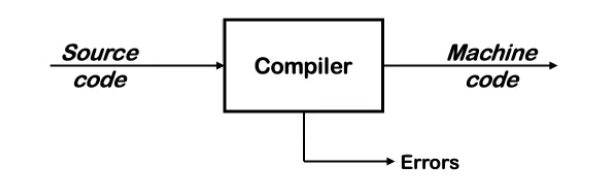
Implications:
- Must recognize legal (and illegal) programs
- Must generate correct code
- Must manage storage of all variables (and code)
- Must agree with OS & linker on format for object code
- Big step up from assembly language - use higher level notations
Traditional Two-pass Compiler

Implications:
- Use an intermediate representation (IR)
- Front end maps legal source code into IR
- Back end maps IR into target machine code
- Extension: multiple front ends & multiple passes (better code)
- Typically, front end is O(N) or O(n log n), while back end is NP-complete
A Common Fallacy
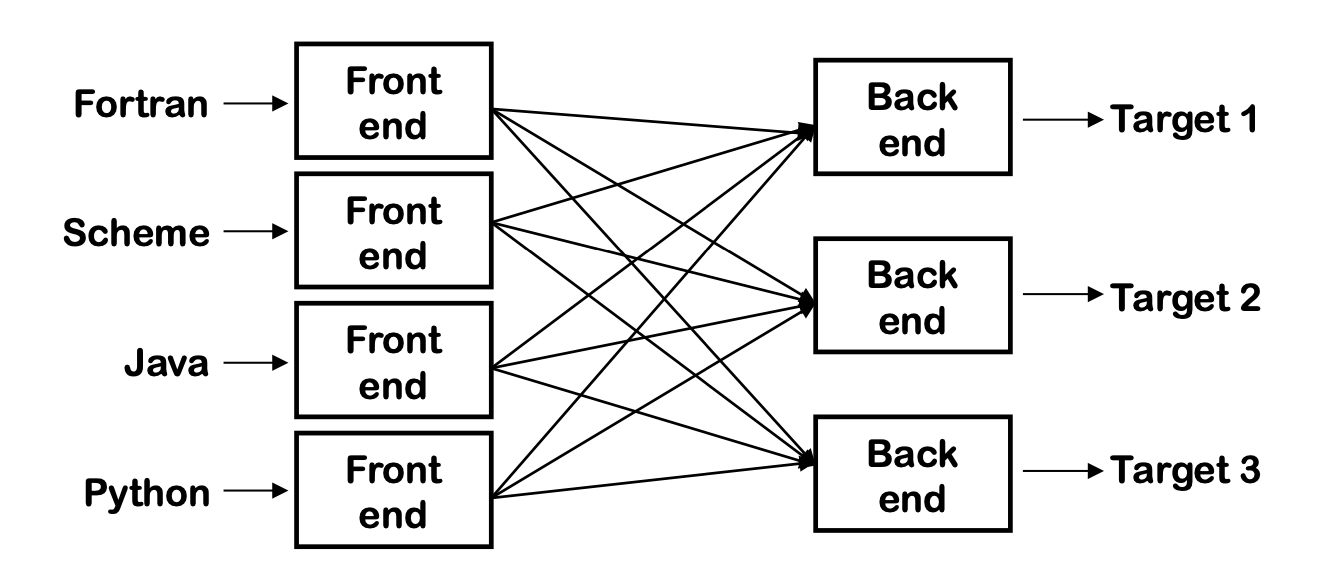
Can we build n x m compilers with n + m components?
- Must encode all language specific knowledge in each front end
- Must encode all features in a single IR
- Must encode all target specific knowledge in each back end
- Limited success in systems with very low-level IRs
The Front End

Responsibilities:
- Recognize legal (& illegal) programs
- Report errors in a useful way
- Produce IR & preliminary storage map
- Shape the code for the back end
- Much of front end construction can be automated
Scanner
- Maps character stream into words - the basic unit of syntax
- Produces pairs - a word & its part of speech
x = x + y;becomes<id,x> = <id,x> + <id,y>;- word ~= lexeme, part of speech ~= token type
- In casual speech, we call the pair a token
- Typical tokens include number, identifier, +, -, new, while, if
- Scanner eliminates white space (including comments)
- Speed is important
Parser
- Recognizes context-free syntax & reports errors
- Guides context-sensitive (“semantic”) analysis (type-checking)
- Builds IR for source program
- Hand coded parsers are fairly easy to build
- Most books advocate using automatic parser generators
Context-free Syntax
Context-free syntax is specified with a grammar
SheepNoise -> SheepNoise baa
                  | baa
This grammar defines the set of noises that a sheep makes under normal circumstances.
It is written in a variant of Backus-Naur Form (BNF)
Formally, a grammar $G = (S, N, T, P)$
- $S$ is the start symbol
- $N$ is the set of non-terminal symbols
- $T$ is a set of terminal symbols or words
- $P$ is a set of produictions or rewrite rules ($P: N \rarr N \cup T$)
Context-free syntax can be put to better use
Context-free Grammar
1. goal -> expr
2. expr -> expr op term
3.       | term
4. term -> number
5.       | id
6. op   -> +
7.       | -
S = goal
T = { number, id, +, - }
N = { goal, expr, term, op }
P = { 1, 2, 3, 4, 5, 6, 7 }- This grammar defines simple expressions with addition & subtraction over “number” and “id”
- This grammar, like many, falls in a class called “context-free grammars”, abbreviated CFG
Given a CFG, we can derive sentences by repeated substitution
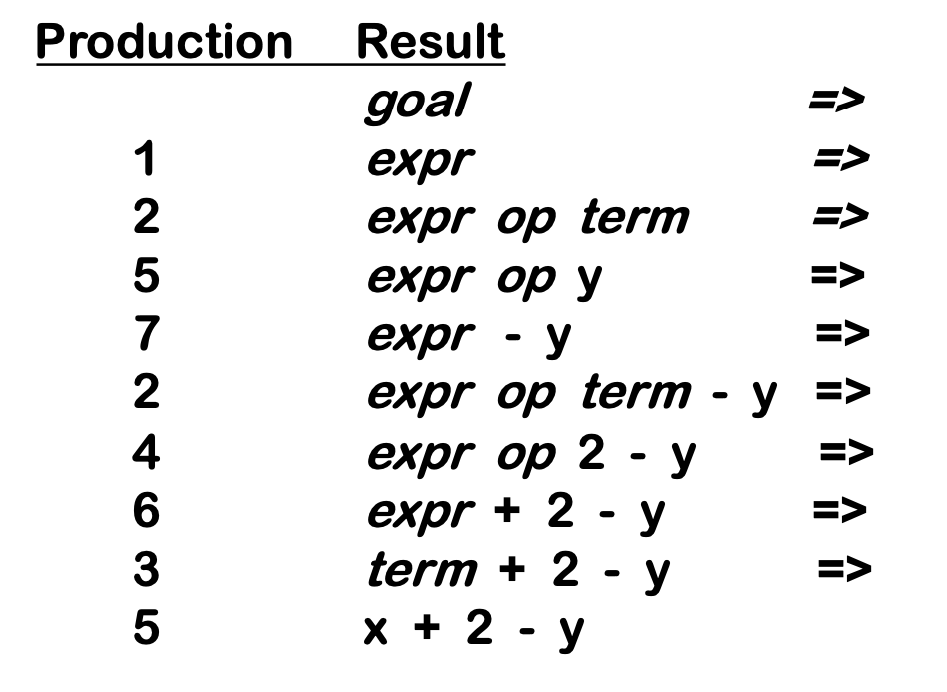
To recognize a valid sentence in some CFG, we will need to construct a derivation automatically (forward or backwards)
Parse Trees
A parse can be represented by a tree (parse tree or syntax tree)
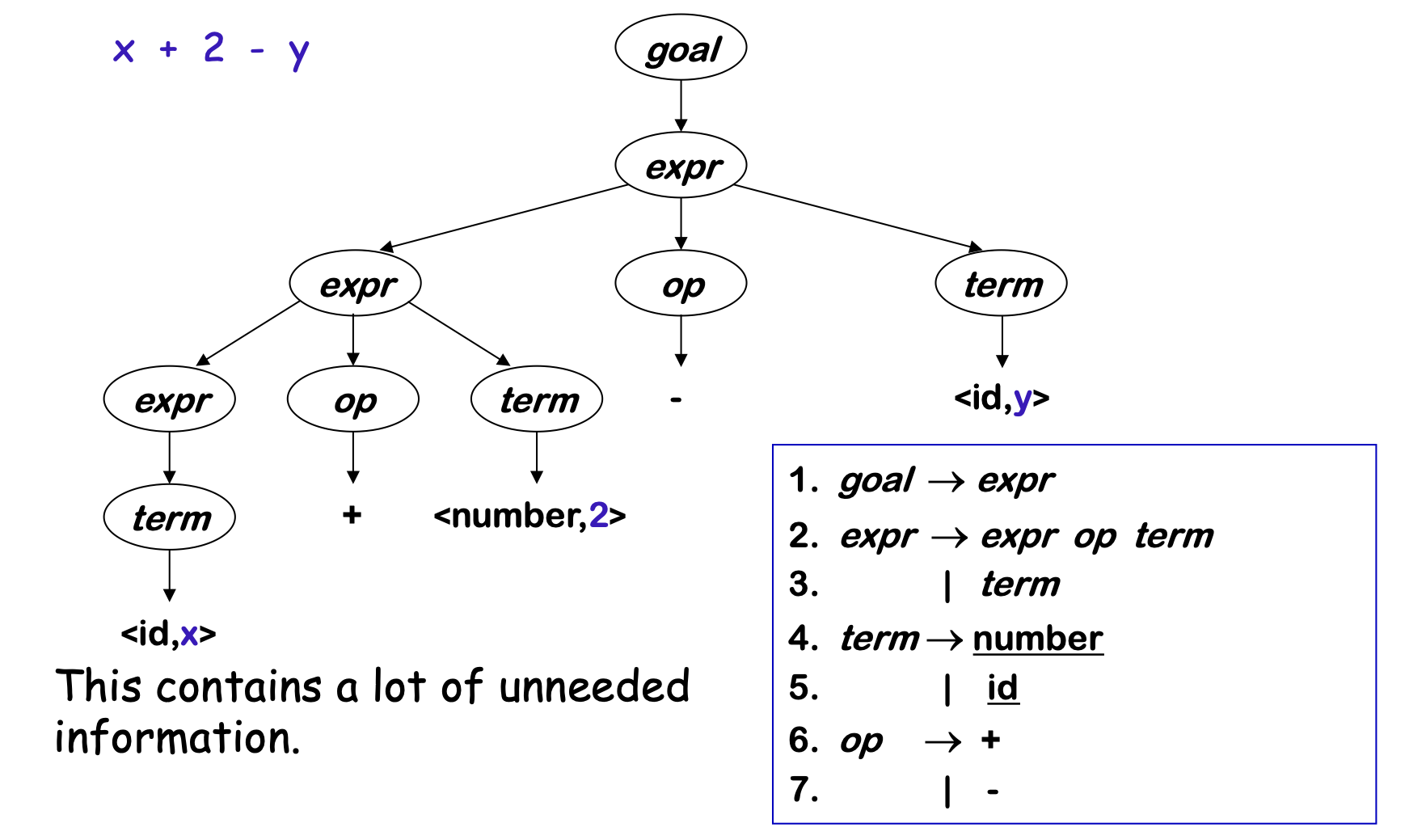
Compilers often use an abstract syntax tree (AST)
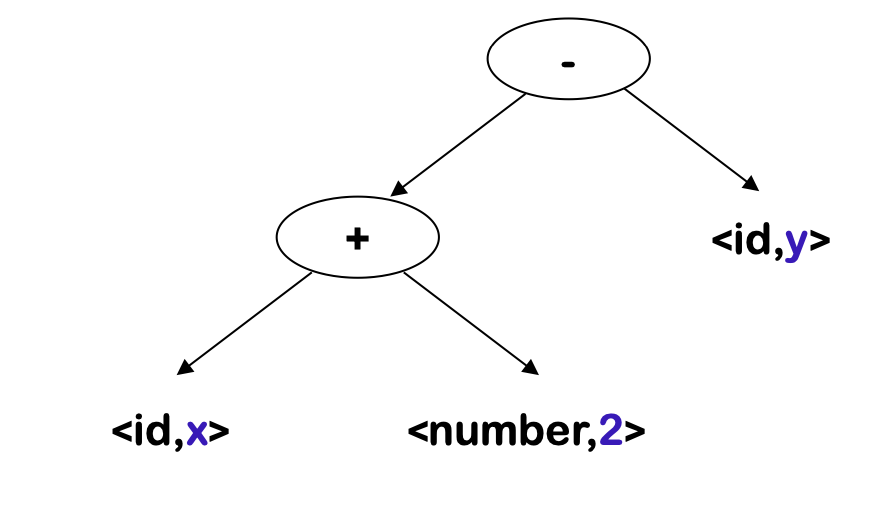
- The AST summarizes grammatical structure, without including detail about the derivation
- This form is much more concise
- ASTs are one kind of intermediate representation (IR)
The Back End
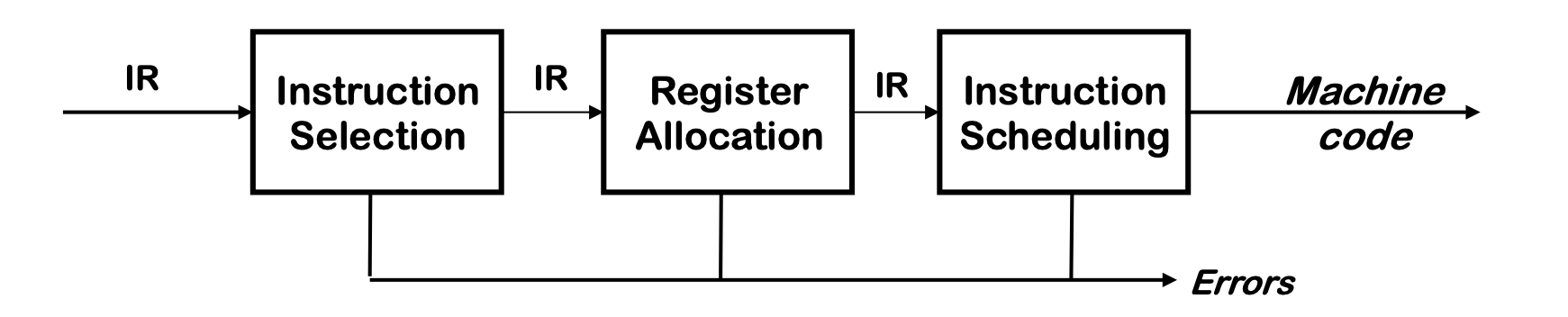
Responsibilities:
- Translate IR into target machine code
- Choose instructions to implement each IR operation
- Decide which value to keep in registers
- Ensure conformance with system interfaces
- Automation has been less successful in the back end
Instruction selection
- Produce fast, compact code
- Take advantage of target features such as addressing models
- Usually viewed as a pattern matching problem
- ad hoc methods, pattern matching, dynamic programming
- This was the problem of the future in 1978
- Spurred by transition from PDP-11 to VAX-11
- Orthogonality of RISC simplified this problem
Register Allocation
- Have each value in a register when it is used
- Manage a limited set of resources
- Select appropriate
LOADs andSTOREs - Optimal allocation is NP-complete
Typically, compilers approximate solutions to NP-Complete problems
Instruction Scheduling
- Avoid hardware stalls and interlocks
- Use all functional units productively
- Can increase lifetime of variables (changing the allocation)
Optimal scheduling is NP-Complete in nearly all cases Heuristic techniques are well developed
Traditional Three-pass Compiler
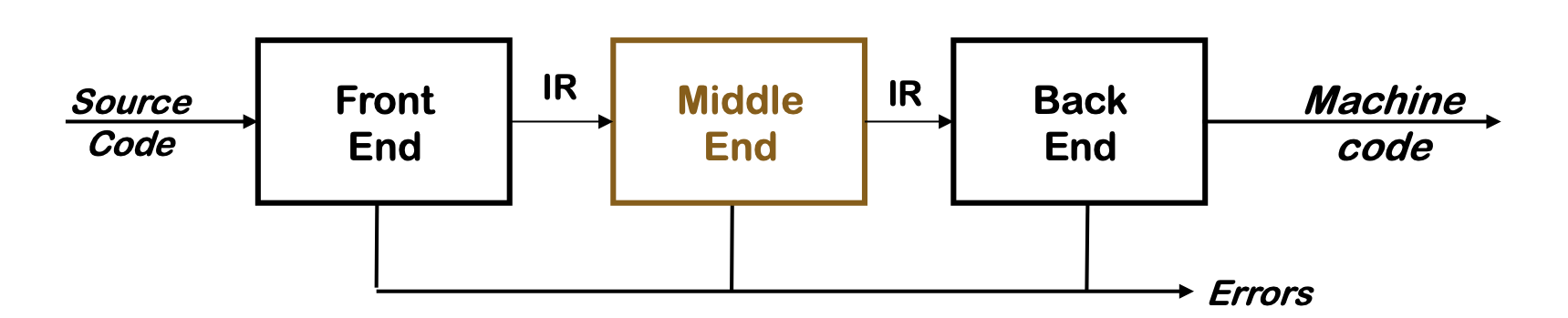
Code improvement (or Optimization)
- Analyzes IR and rewrites (or transforms) IR
- Primary goal is to reduce running time of the compiled code
- May also improve space, power dissipation, energy consumption
- Must preserve “meaning” of the code (may include approximations, i.e., quality of outcomes trade-offs)
The Optimizer (or Middle End)
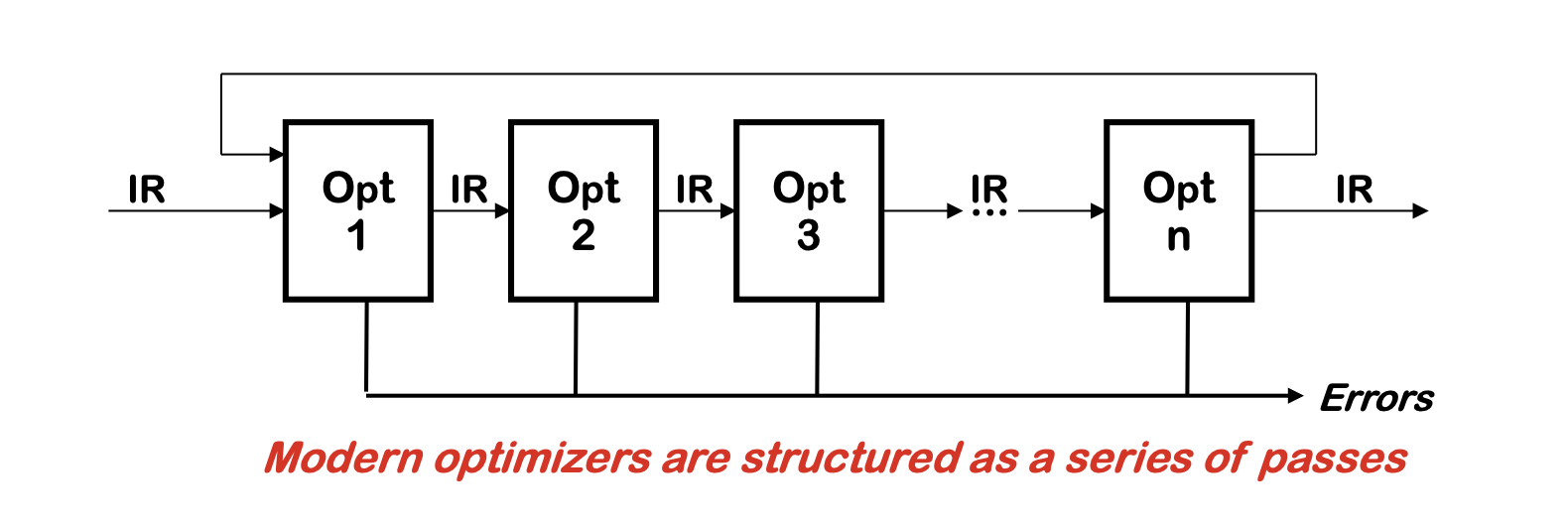
Typical Transformations
- Discover & propagate some constant value
- Move a computation to a less frequently executed place
- Specialize some computation based on context
- Discover a redundant computation & remove it
- Remove useless or unreachable code
- Encode an idiom in some particularly efficient form
Modern Restructuring Compiler

Typical Restructuring (source-to-source) Transformations:
- Blocking for memory hierarchy and register reuse
- Vectorization
- Parallelization
- All based on dependence
- Also full and partial inlining
Rule of the Run-time system
- Memory management services
- Allocate
- In the heap or in an activation record (stack frame)
- Deallocate
- Collect garbage
- Allocate
- Run-time type type-checking
- Error processing (exception handling)
- Interface to the operating system
- Input and output
- Support for parallelism
- Parallel thread initiation
- Communication and synchronization