Lecture 23 - Procedure Abstraction
The Procedure: 3 Abstractions
- Control abstraction
- Well defined entries & exits
- Mechanism to return control to caller
- Some notion of parameterization (usually)
- Clean Name Space
- Clean state for writing locally visible names
- Local names may obscure identical, non-local names
- Local names cannot be seen outside
- External Interface
- Access is by procedure name & parameters
- Clear protection for both caller & callee
- Procedures permit a critical separation of concerns
The Procedure (Realist’s View)
Procedures allow us to separate compilation
- Separate compilation allows us to build non-trivial programs
- Keeps compile times reasonable
- Lets multiple programmers collaborate
- Requires independent procedures
Without separate compilation, we would not build large systems
The procedure linkage convention
- Ensures that each procedure inherits a valid run-time environment and that the callers environment is restored on return
- The compiler must generate code to ensure this happens according to conventions established by the system
The Procedure (More Abstract View)
A procedure is an abstract structure constructed via software
Underlying hardware directly supports little of the abstraction - it understands bits, bytes, integers, reals, and addresses, but not
- Entries and exits
- Interfaces
- Call and return mechanisms
- May be a special instruction to save context at point of call
- Name space
- Nested scopes
All these are established by a carefully-crafted system of mechanisms provided by compiler, run-time system, linkage editor and loader, and OS
Run Time vs. Compile Time
These concepts are often confusing
- The procedure linkages execute at run time
- Code for the procedure linkage is emitted at compile time
- The procedure linkage is designed long before either of these
The Procedure as a Control Abstraction
Procedures have well-defined control-flow
The Algol-60 procedure call
- Invoked at a call site, with some set of actual parameters
- Control returns to call site, immediately after invocation
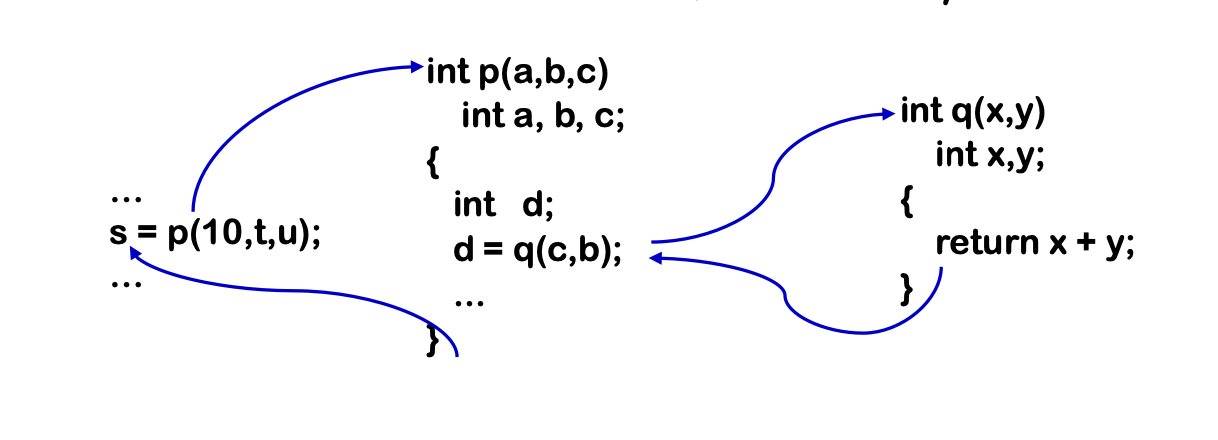
- Most languages allow recursion
Implementing procedures with this behavior
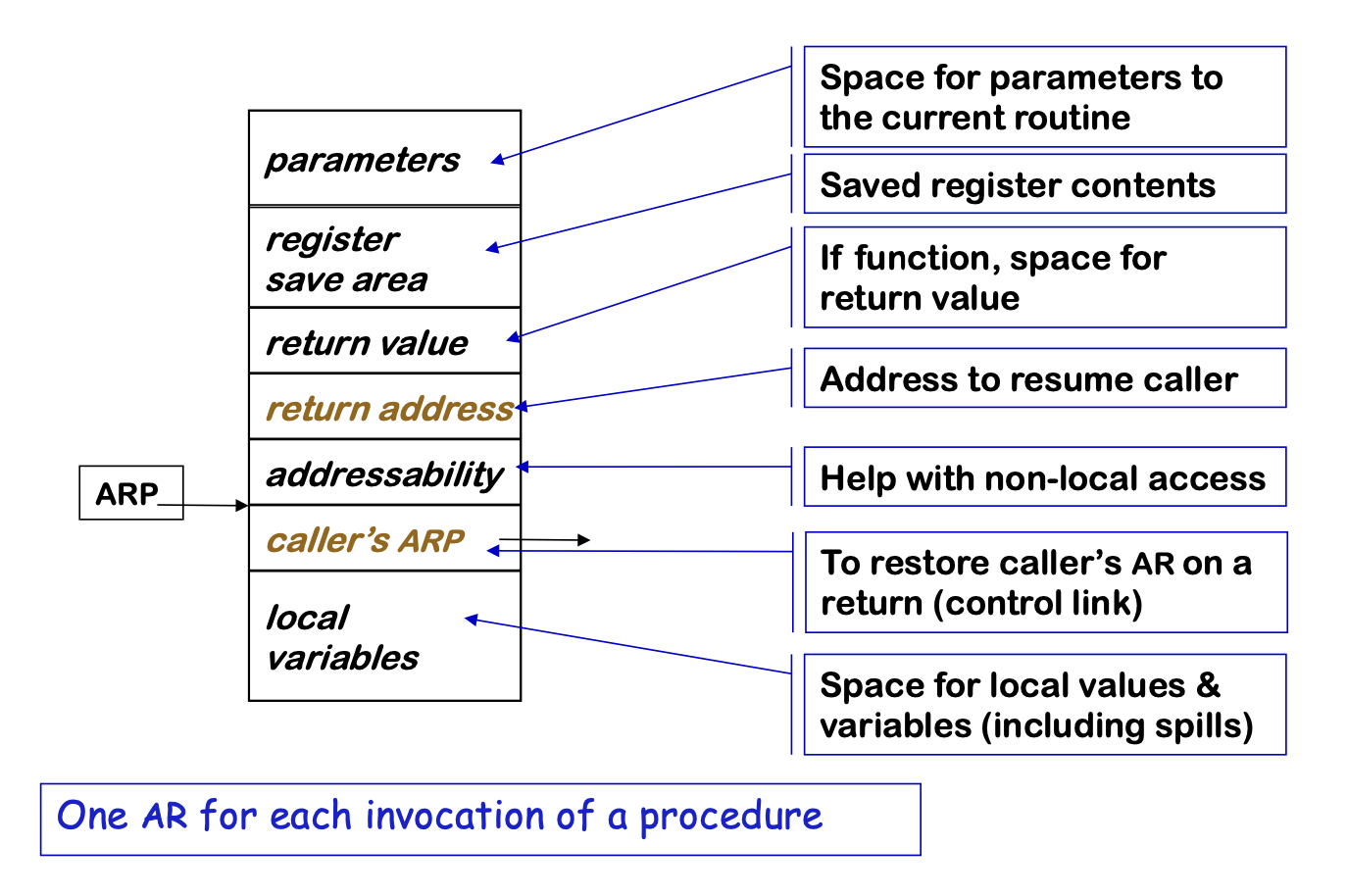
- Requires code to save and restore a “return address”
- Must map actual parameters to formal parameters
- Must create storage for local variables (any, maybe, parameters)
- p needs space for d (and, maybe, a, b, and c)
- where does this space go in recursive invocations?
- Must preserve p’s state while q executes
- Recursion causes the real problem here
- Strategy: Create unique location for each procedure activation
- Can use a “stack” of memory blocks to hold local storage and return addresses
- Compiler emits code that causes all this to happen at run time
The Procedure as a Name Space
Each procedure creates its own name space
- Any name (almost) can be declared locally
- Local names obscure identical non-local names
- Local names cannot be seen outside the procedure
- Nested procedures are “inside” by definition
- We call this set of rules & conventions “lexical scoping”
Examples:
- C has global, static, local, and block scopes
- Blocks can be nested, procedures cannot
- Scheme has global, procedure-wide, and nested scopes
- Procedure scope (typically) contains format parameters
Why introduce lexical scoping?
- Provides a compile-time mechanism for binding “free” variables
- Simplifies rules for naming & resolves conflicts
- How can the compiler keep track of all those names?
The Problem
- At point p, which declaration of x is current?
- At run-time, where is x found?
- As parser goes in & out of scopes, how does it delete x?
The answer:
- Lexically scoped symbol tables
Where do all these variables go?
- Automatic & Local
- Keep them in the procedure activation record or in a register
- Automatic => lifetime matches procedure’s lifetime
- Static
- Procedure scope => storage area affixed with procedure name
- File scope => storage area affixed with file name
- Lifetime is entire execution
- Global
- One or more global data areas
- One per program
- Lifetime is entire execution
Placing Run-time Data Structure
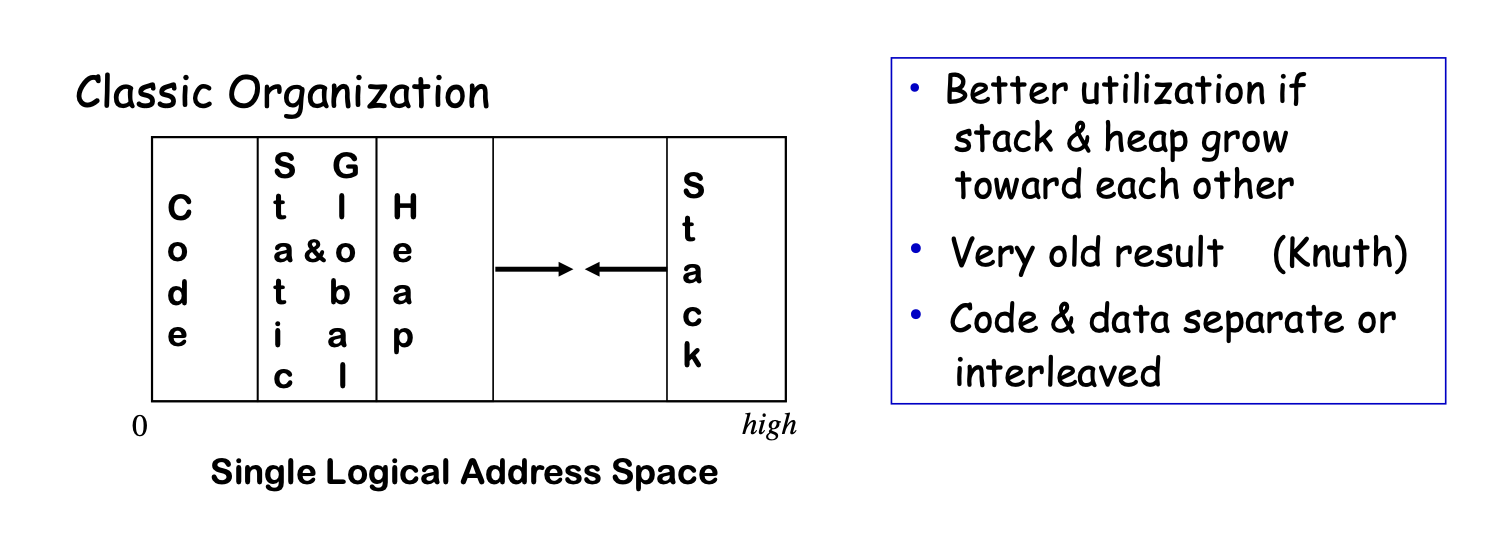
- Code, static, and global data have known size
- Heap and stack both grow & shrink over time
- This is a virtual address space
Activation Record Basics