
Food Subsidies & Health: The Connection
5 Broad Food Industry Groups
- Grain and oilseeds
- Fruits and vegetables
- Cattle
- Dairy
- Hogs, poultry, and eggs
Grain and Oilseeds
- Souped-up engine of the American agricultural economy
- Grains with greatest total value: corn, followed by Soybeans
- Grains with greatest food value: wheat, followed by rice
- *Large, very large family farms prominent in grain and oilseeds
Fruits and Vegetables
- Fruit and Nut Toppers: grapes, oranges, apples, almonds, strawberries
- Vegetable Toppers: potatoes, lettuce, tomatoes
- No clear distinction between fruits & vegetables
- Tomato?
- Way back in the day, fruits had no import tax while vegetables do have an import tax
- Economic ramifications; Tomato classified as a vegetable
- Centralization of food system
- Fast food industry demands uniform products encouraging centralization of every agricultural sector
- Fruits & vegetables, now grown, packaged and shipped like industrial commodities
Reasons for food safety concerns and reporting of outbreaks
- Improved reporting of outbreaks
- Aging population with weakened immune system, susceptible to food-borne illnesses
- Much produce eaten without cooking
Food safety Regulatory system
- Responsibility of local, state and federal agencies
- Quicker response to localized public health problems
- Example, states responsible for safe milk and sanitary operations of restaurants
- New Jersey; bans sale of raw milk
Reasons why burgers are cheaper than salads
- Production costs
- Transportation and storage costs
Unhealthful foods, with the exceptions of cookies, have gotten a lot cheaper since 1978
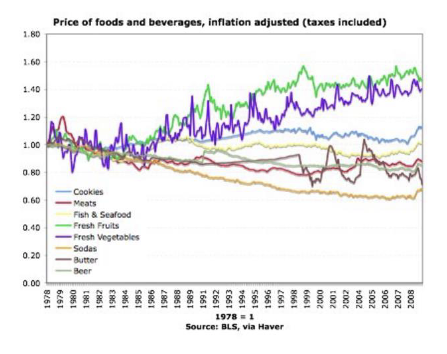
- Sodas are 33% cheaper
- Butter is 29% cheaper
- Beer is 15% cheaper
- Fish is 2% more expensive
- Vegetables are 41% more expensive
- Fruits are 46% more expensive
Corn
- Dent corn = field corn; livestock feed
- Not necessarily unhealthy
- Simultaneously a fruit, a grain and a vegetable
- Target for food cops
Corn subsidies making us fat?
- Federal farm subsidies always make our foods cheaper, leading to over-consumption: true or false?
- NOT ALWAYS TRUE
- But at times, farm subsidies lowered price of US farm commodities
- Example: grain price, if lowered will lower the price of producing breakfast cereals, or bread
Common notion: obesity can be curbed by increased consumption of fruits & vegetables
- By removing subsidies of grains, caloric consumption will be reduced; research shows an average adult weight would decline by only .35 lbs/person/year
- No compelling evidence that doing so would have much influence on obesity
FACT: Increased subsidy is given to corn for fuel more than food
Sin tax
- Gaining momentum
- Fat tax, a levy on sugary drinks and other unhealthy food products associated with obesity
Farm Subsidies
-
Farm subsidies are government financial benefits paid to specific industries, like agribusiness
-
Help reduce risk for farmers during bad seasons
-
They have evolved to be very complex. As a result, Only large producers can take advantage of farm subsidies
-
Why grains? Grains provide 80% of the world’s caloric needs. Grains can also be stored and affordably shipped.
-
The top five states receiving subsidies are Texas, Nebraska, Kansas, Arkansas, and Illinois.
-
Corn is the nation’s biggest crop.
-
More than 15 billion bushels were grown in 2017, with 15% exported. The corn belt is Indiana, Illinois, Iowa, Missouri, Nebraska, and Kansas. A third of Iowa’s economy depends on farming.
-
California produces the most food by value. Most of its almonds, wine, dairy, walnuts, and pistachios. These aren’t subsidized
-
Grains are the most heavily subsidized, making them cheaper than vegetables and fruits. As a result, grains make up one-fourth of the average American diet.
-
Oil made from corn, soybeans, and canola contributed another quarter. Fruits and vegetables are less than 10%
-
More than 6% of farm subsidies go toward four “junk food” components: corn syrup, high-fructose corn syrup, corn starch, and soy oils.
-
The problem is that subsidized commodities financed by these policies are not exactly aligned with U.S. dietary guidelines
-
Current Dietary Guidelines for Americans emphasizes consumption of fruits, vegetables, whole grains, lean protein, and low-fat dairy while limiting consumption of saturated fats, sugars, salts, and refined grains.
-
However, U.S. subsidies focus on financing the production of foods like corn, soybeans, wheat, rice, dairy and livestock.
People often prefer “default” options
- Scenario:
- Sandwich + fries by default; salad an option for fries
- If Sandwich + salad by default; fries an option
- A healthier choice available
Food decisions are often based more on emotion than rational thought
- Impulsive behavior
- Better lighting / attractive containers / more choice of fruits & vegetables
People have problems with self-control when choosing food
- Immediate satisfaction
- Cravings
- Preselect healthier choices - an option
External cues
- External cues can have a major effect of the food selected, the amount consumed, and an eater’s perception of how much was consumed