
Why do we eat the foods we eat?
Food for Thought: Expectation Assimilation
-
In this study, researchers wanted to know if what you think about food effects how you eat.
-
Researchers got $2 wine and put two different labels on them
-
One said the wine was from North Dakota and the other one said the wine was from California
-
Researchers wanted to know if this thought expectation changed people’s expectation of taste.
-
Sure enough, people who got the California wine said the wine tested better AND the entire meal tasted better. People who got the North Dakota bottle rated the wine and the meal lower.
-
The notion that our taste perceptions are biased by our imagination, and if you expect a food to taste good it will. And if you expect a food to taste unpleasant it will.
Age appears to be a factor that significantly determines what and why one eats and drinks
-
Older adults (45-69 years) tend to plan their eating and drinking as part of a meal more than younger respondents.
-
Older adults also appear to depend on routine to trigger their eating and drinking more than younger adults.
-
They suggested that time of day was a more important trigger for them than hunger or thirst
-
Nutrition experts often discuss moderation of food and beverage consumption. However, what motivates the average person to stop eating is rarely eating a “healthy serving size.”
-
The 3 main reasons they stopped eating were “the food was gone”, “I felt satisfied”, followed by “I had eaten enough”
Specialists vs. Generalists
-
Specialists
- Consume limited number of foods
- Examples: Koalas - eucalyptus leaves; Carnivores - meat
- Advantage - requires less natural resources compared to generalists
- Disadvantage - much more limited in food source
-
Generalists
- Omnivores - consume variety of foods
- Examples: humans, rats, bears, pigs
Sensory Characteristics
-
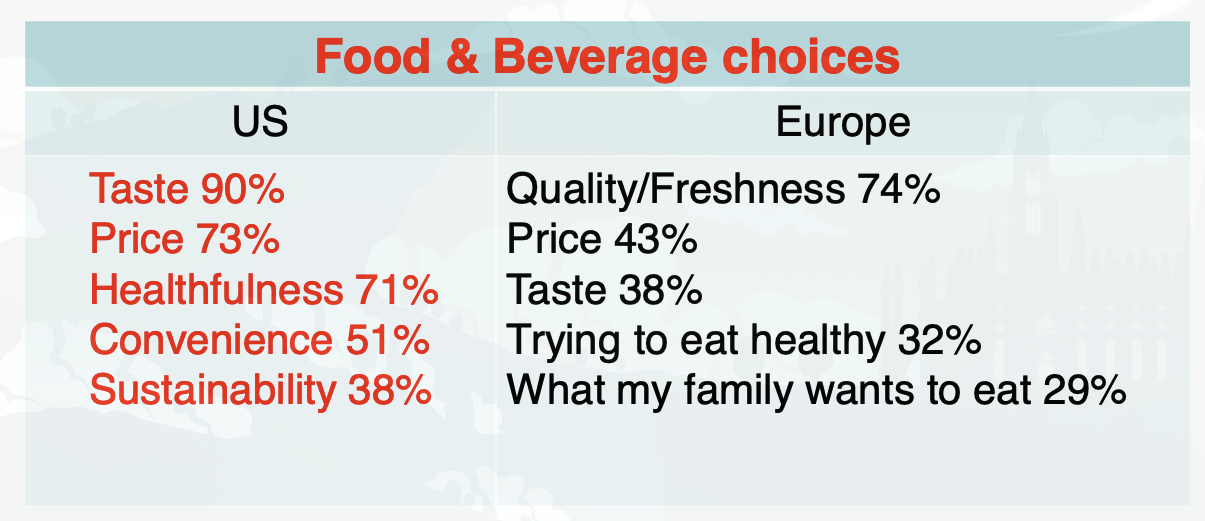
Taste is the #1 factor to determine our food choices
-
No matter how nutritious, safe and high quality a product is, if it does not taste good, we will not be likely to choose it
-
Actually, it is a combination of all the sensory characteristics- flavor, appearance, and texture
-
Eyes, ears, tongue, mouth: all of these organs contribute to “Tastes” of foods
Taste + Smell + Flavor
-
Taste & smell: work together to establish flavor of a food or beverage; smell plays the primary role
-
Smell is arguably more important than taste
-
When we chew, aromas are released to activate our sense of smell by the way of a special channel that connects the roof of the throat to the nose
Appearance Factors
- 2 Categories
1. Color
- If colors do not match the perception of the consumer, they may not purchase the product
- Have you seen green ketchup?
- Alternate color choices are short-lived
2. Geometric attributes: Size and Shape
- Consumer expectations
- Computerized electronic equipment determine the size and shape of the food we consume at the factories
Flavor
- Combination of taste and smell
- Most of what we perceive as taste, is actually smell
Texture
- Feeds to our sense of food
- Does not seem important; but that is the one that leads to our rejection of foods
Taste preferences
- Genetic makeup
- Has a lot to do with which tastes we find appealing & which ones we cannot tolerate
- Life’s experiences
- Also shape taste preferences
- Complicated
- Each taste quality - sweet, sour, salty, bitter, umami- is like a separate sense
- They all start in the same taste bud - the organ of taste in our tongue
Complicated taste
-
More complicated than hearing, vision, etc.
-
Human’s have at least 25 different receptors to sense bitter tastes… Why?
-
Bitter
- Tasting things that are often toxic, so being sensitive to bitter tastes is critical for survival
-
Spoilt food tastes dour
- So we turn away from things that are spoiled or dangerous
-
Bitter and sour are termed “aversive” tastes
- Humans tend not to like these tastes
-
Salty, sweet and umami: “appetitive” tastes
- Sweet = calories; a natural signal
- Salty = minerals needed for proper body’s functioning
- Umami/savory = taste of protein
Taste system
-
The brain detects the taste of food
-
Smell or olfaction is a chemical sense
-
Occurs in 2 ways
- Directly through the nose
- Retro nasally - when you chew food, chemicals in the food vaporize and stimulate the nose from the back
-
Human’s are capable of identifying 1000s of odors
-
Smell is a more “plastic sense”: driven by experiences, learning
-
The Aroma of foods is believed to account for as much as 80-85% of the flavor of food
How to develop products successfully for the population
- ** Most product developers target 50% or so of the population described as tasters
- Those with middle-of-the-road taste sensibilities
- Low end: not picky
- Super tasters: picky
- Need to design foods for the center of the bell curve