
Lecture 2
Backend - Register Allocation
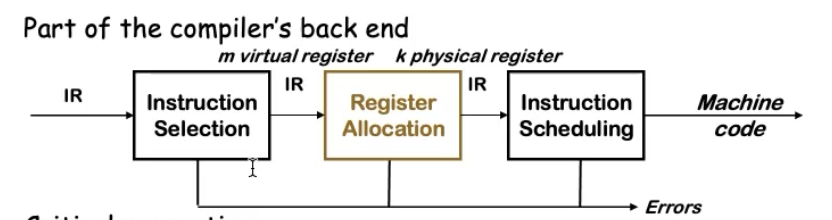
Critical properties:
- Produce correct code that uses k (or fewer) registers
- Minimize added loads and stores
- Minimize space used to hold spilled values
- Operate efficiently: O(n), O(nlog2n), maybe O(n^2), but not O(2^n)
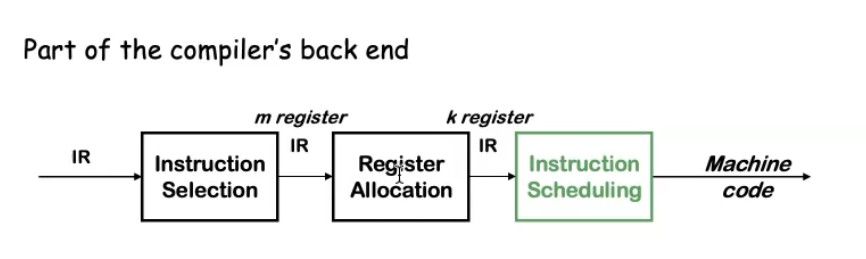
Instruction Scheduling
Motivation
- Instruction latency (pipelining)
- Several cycles to complete instructions; instructions can be issued every cycle
- Instruction level paralellelism (VLIW, superscalar)
- Execute multiple instructions per cycle
Issues
-
Reorder instructions to reduce execution time
-
Static schedule - insert NOPs to preserve correctness
-
Dynamic schedule - hardware pipeline stalls
-
Preserve correctness, improve performance
-
Interactions with other optimizations (register allocation!)
-
Note: After register allocation, code shape contains real, not virtual registers ==> register may be redefined
-
ILOC simulator “sim” is available on ilab at
~uli/cs415/ILOC_Simulator/sim
Local Instruction Scheduling
Readings: EaC 12.1-12.3, Appendix A (ILOC)
Definition: A basic block is a maximal length segment of straight line (i.e., branch free) code. Control can only enter at first instruction of basic block and exist after last instruction.
Local: within single basic block Global: across procedures/functions
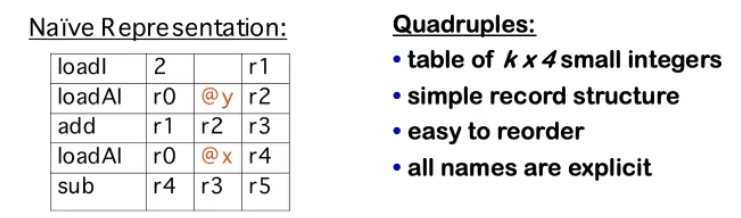
ILOC (Intermediate Language for Optimizing Compilers)
Instruction scheduling on basic blocks in “ILOC”
- Pseudo-code for a simple, abstracted RISC machine
- generated by the instruction selection process
- Simple, conmpact data structures
- Here: we only use a small subset of ILOC
- ILOC simulator “sim” is available on ilab at
~uli/cs415/ILOC_Simulator/sim
Memory Model / Code Shape
- Source code:
A = 5;
B = 6;
C = A + B;
Memory layout:
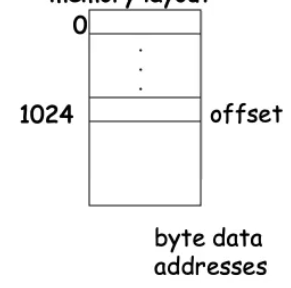
Assume A, B, C are integer values of 4 bytes
address(A) = 1024 + offset(A) = 1028
address(B) = 1024 + offset(B) = 1032
address(C) = 1024 + offset(C) = 1036
More generally: address(X) = base_address + offset(X)
This convention is used in activation records or stack frames. We use it here for consistency
ILOC Code:
loadI 5 => r1
// compute address of A in r2
...
store r1 => r2 // content(A) = r1
loadI 6 => r3
// compute address of B in r4
...
store r3 => r4 // content(B) = r3
add r1, r3 => r5
// compute address of C in r6
...
store r5 => r6 // content(C) = r1 + r3
Is this code correct?
foo (var A, B)
  A = 5;
  B = 6;
  C = A + B;
end foo;

X = 1
call foo(X,X);
print C;
Incorrect for call-by-reference!
Aliasing Problem
- Aliasing: Two variables or source code names may refer to the same memory location
Examples:
- Formal call-by-reference parameters a and b
- Pointers
a->fandb->f - Array elements
a(i,j)anda(k,l)ifi == kandj == l
Channlenge: When is it safe to keep a variable’s value in a register across STORE instructions, i.e., while other STORE instructions are executed?
Memory Models
-
Register-register Model (We will use this one from now on)
- Values that may safely reside in registers are assigned to a unique virtual register (alias analysis)
- Register allocation/assignment maps virtual registers to limited set of physical registers
- Register allocation/assignment pass needed to make code “work”
-
Memory-Memory Model
- All values reside in memory, and are only kept in registers as briefly as possible (load operands from memory, perform computation, store result into memory)
- Register allocation/assignment has to try to identify cases where values can be safely kept in register
- Safety verification is hard at the low levels of program abstraction
- Even without register allocation/assignment, code will “work”