
Lecture 18 - Context-Sensitive Analysis Part 2
Midterm #2
- Regular Expressions
- NFA and DFA
- Regular Expressions to minimal DFA construction
- CFG
- Derivations
- Parse Trees
- ambiguity
- LL(1) parsing
- FIRST and FOLLOW sets
- Parse tables
- Recursive descent parsers
- LR(0) parsing
- LR(0) items
- LR(0) canonical collection and its construction
- ACTION and GOTO tables
- Shift/reduce and reduce/reduce conflicts
Attribute Grammars, cont.
The Problems:
- Copy rules increase cognitive overhead
- Copy rules increase space requirements
- Need copies of attributes
- Result is an attributed tree
- Must build the parse tree
- Either search tree for answers or copy them to the root
Addressing the Problem
What would a good programmer do?
- Introduce a central repository for facts
- Table names
- Field in table for loaded/not loaded state
- Avoid all the copy rules, allocation & storage headaches
- All inter-assignment attribute flow is through table
- Clean, efficient implementation
- Good techniques for implementing the table
- When it’s done, information is in the table
- Cures most of the problems
- Unfortunately, this design violates the functional, AG paradigm
- Do we care?
The Realist’s Alternative
Ad-hoc syntax-directed translation
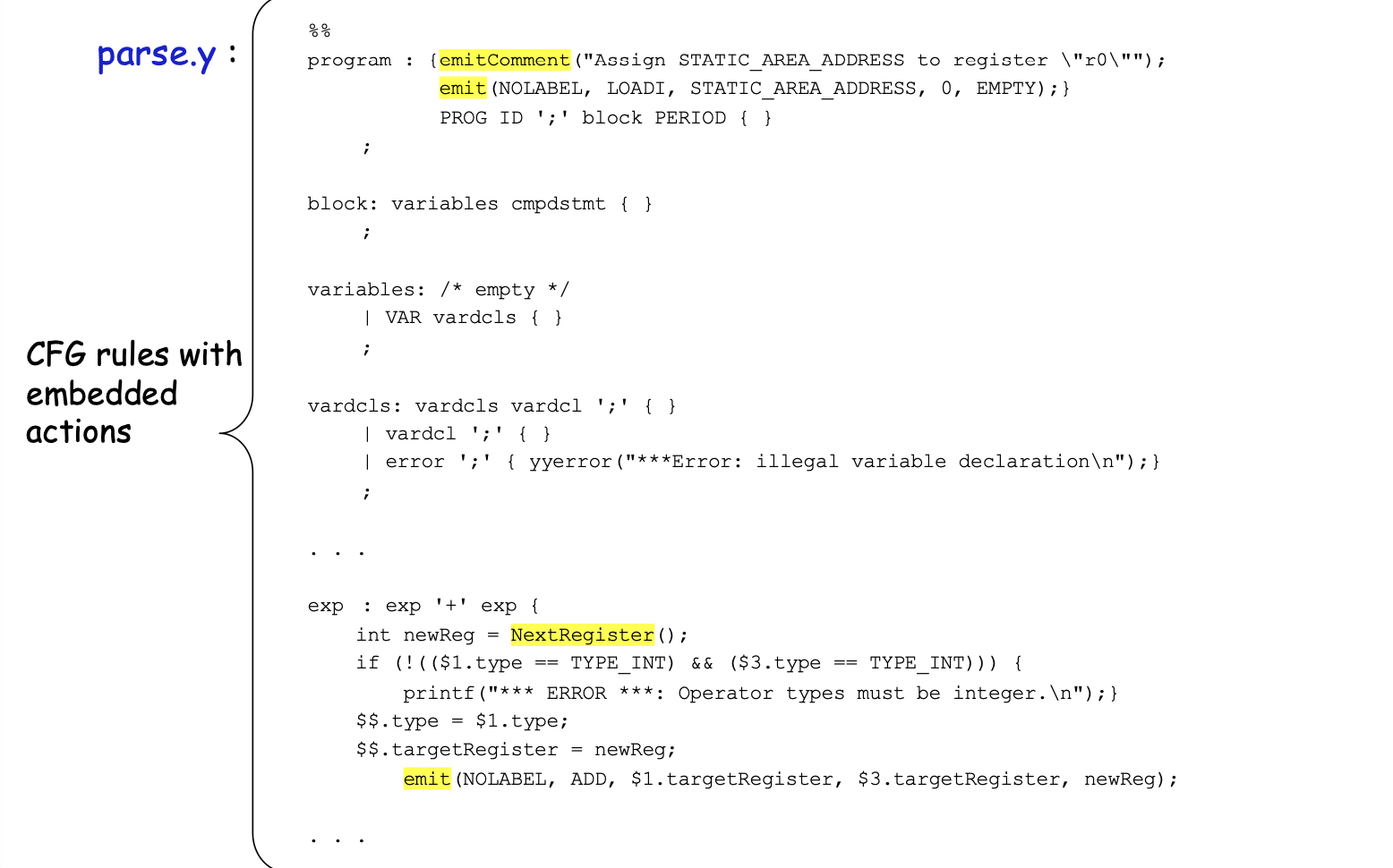
- Associate pieces of code with each production
- At each reduction, the corresponding code is executed
- Allowing arbitrary code provides complete flexibility
- Includes ability to do tasteless and bad things
To make this work:
- Need names for attributes of each symbol on lhs and rhs
- Typically, one attribute passed through parser + arbitrary code (structures, globals, …)
- Yacc introduced $$, $1, $2, …, $n, left to right
- Need an evaluation scheme
- Fits nicely into LR(1) parsing algorithm
Project 2
- You do not have to change the scanner (scan.l)
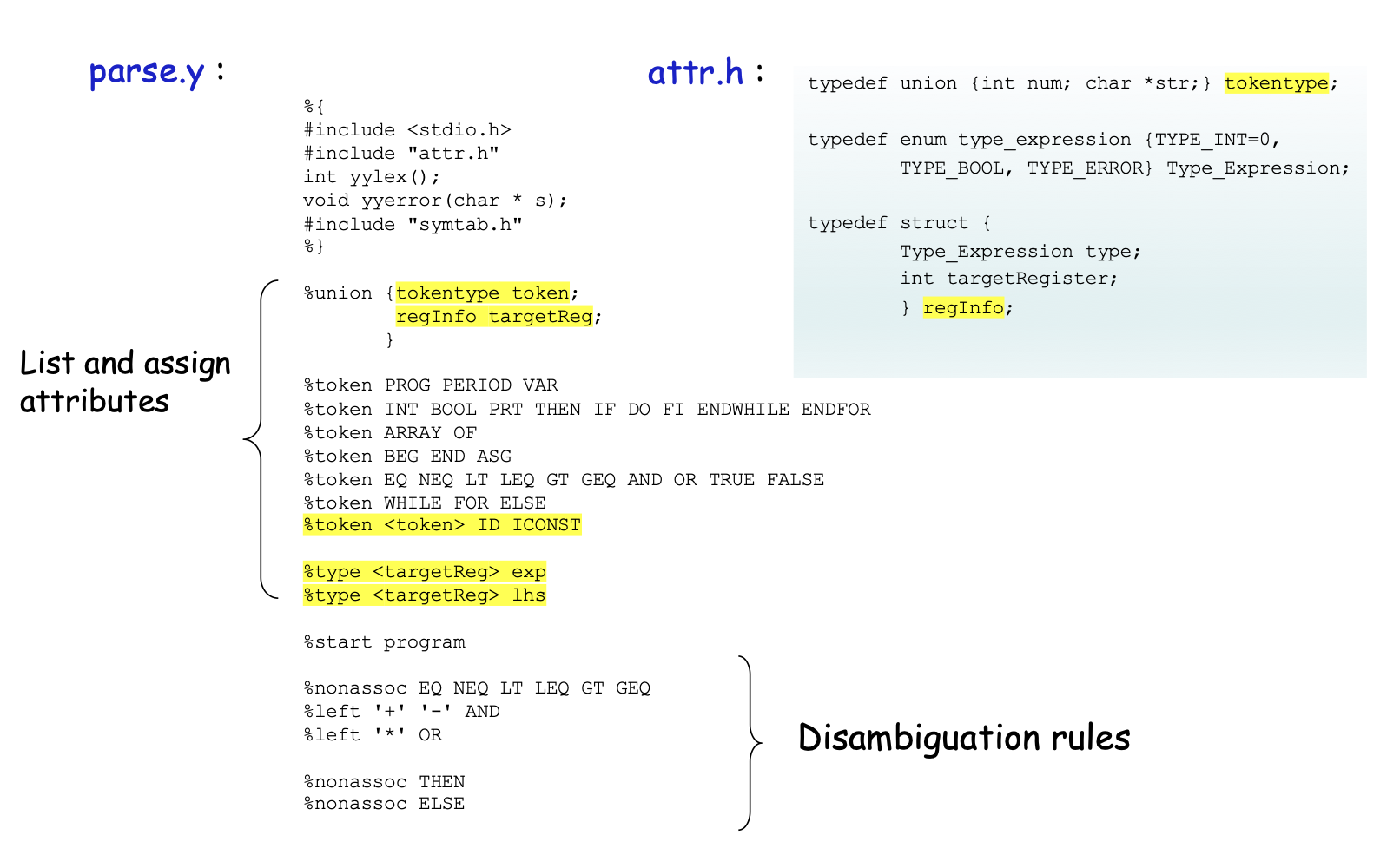
- How to specify and use attributes in YACC?
- Define attributes as types in
attr.h typedef struct info_node { int a; int b } infonode;
- Define attributes as types in
- Include type attribute name in
%unionin parse.y%union {tokentype token; infonode myinfo; ... }
- Assign attributes in
parse.yto- Terminals:
%token <token> ID ICONST - Non-terminals:
%type <myinfo> block variables procdecls cmpdstmt
- Terminals:
- At each reduction, the corresponding code is executed.
- Accessing attribute values in parse.y:
- use $$, $1, $2, …, etc. notation:
- \s
block : variables procdecls {$2.b = $1.b + 1;} cmpdstmt { $$.a = $1.a + $2.a + $4.b; } - Implemented as
block : variables procdecls newsymbol cmpdstmt
        { $$.a = $1.a + $2.a + $4.b; }
newsymbol: ∈ {$2.b = $1.b + 1;}
Summary - is this really ad-hoc?
Relationship between practice and attribute grammars
Similarities
- Both rules & actions associated with productions
- Application order determined by tools
- (Somewhat) abstract names for symbols
Differences:
- Actions applied as a unit; not true for AG rules
- Anything goes in ad-hoc actions; AG rules are (purely) functional
- AG rules are higher level than ad-hoc actions
Types and Type Systems
Type: A set of values and meaningful operations on them
Types provide semantic “sanity checks” (consistency checks) and determine efficient implementations for data objects
Types help identify
- errors
- which operation to use for overloaded names and operators, or what type coercion to use (e.g.: 3.0 + 1)
- identification of polymorphic functions
Type System
Type System: each language construct (operator, expression, statement, etc.) is associated with a type expression. The type system is a collection of rules for assigning type expressions to these constructs.
Type expressions for
- basic types:
integer,char,real,boolean,typeError - constructed types, e.g., one-dimensional arrays:
array(lb, ub, elem_type), whereelem_typeis a type expression
A Type Checker implements a type system. It computes or “constructs” type expressions for each language construct